

A 15-Minute Full-Body Stretch Routine for Daily Renewal
Do you ever get to the end of the day and realize you’re holding your shoulders up by your ears? Or that your back has molded itself into the shape of your office chair? I know that feeling all too well. For years, my body felt like a tightly wound knot, a physical manifestation of the stress and hustle I was navigating. My neck ached, my hips felt locked, and I felt a profound sense of being disconnected from my own physical self.
It’s a sensation of being all in your head, while your body is just along for the ride, collecting tension like a suitcase collects travel stickers. But what if we could change that? What if, in just 15 minutes, you could offer your body a thank you, an apology, and a gentle invitation to release and renew?
This gentle, 15-minute full-body stretching routine is my personal go-to for exactly that. It’s not about achieving perfect pretzel shapes or pushing your limits. It’s about cultivating a sense of spaciousness from head to toe, one mindful breath at a time. I’m going to guide you through each stretch, just as I do for myself each evening, helping you create a daily habit of intentional movement that feels less like a chore and more like a gift.
Why a Daily Stretching Habit Matters More Than You Think
In our goal-oriented world, it’s easy to think that for movement to “count,” it has to be intense, sweaty, and long. But I’ve learned that the opposite is often true when it comes to sustainable wellness. The real magic happens in the small, consistent acts of self-care we weave into our daily lives. A short, daily stretching routine is a perfect example of this.
When you stretch mindfully, you’re doing more than just improving your flexibility. You are:
- Releasing Physical Stress: Our muscles clench in response to mental and emotional stress. Gentle stretching sends a signal to your nervous system that it’s safe to relax, helping to melt away that accumulated tension.
- Connecting Mind and Body: How often do you truly pay attention to the sensations in your body? This practice is a moving meditation, bringing your awareness back into your physical self and away from the endless scroll of thoughts. It’s a foundational element of starting a daily mindfulness practice.
- Improving Circulation: Movement gets your blood flowing, delivering oxygen and nutrients to your muscles and tissues, which can leave you feeling more energized and less sluggish.
- Creating a Ritual of Calm: By setting aside this time each day, you’re creating a powerful ritual that signals a transition—from work to rest, from chaos to calm. It becomes a beautiful bookend to your day.
Getting Started: Creating Your Calm Space
Before we begin, let’s set the stage. You don’t need a fancy home gym or expensive gear. The most important thing is your intention. Find a quiet corner where you won’t be disturbed for 15 minutes. It could be on your living room rug, by your bed, or anywhere you have enough space to extend your arms and legs.
Put on some comfortable clothing that allows you to move freely. Maybe you dim the lights or play some soft, instrumental music. The goal is simply to create an environment that feels soothing and signals to your brain that it’s time to unwind. Most importantly, leave your phone on silent and out of arm’s reach. This is your time.
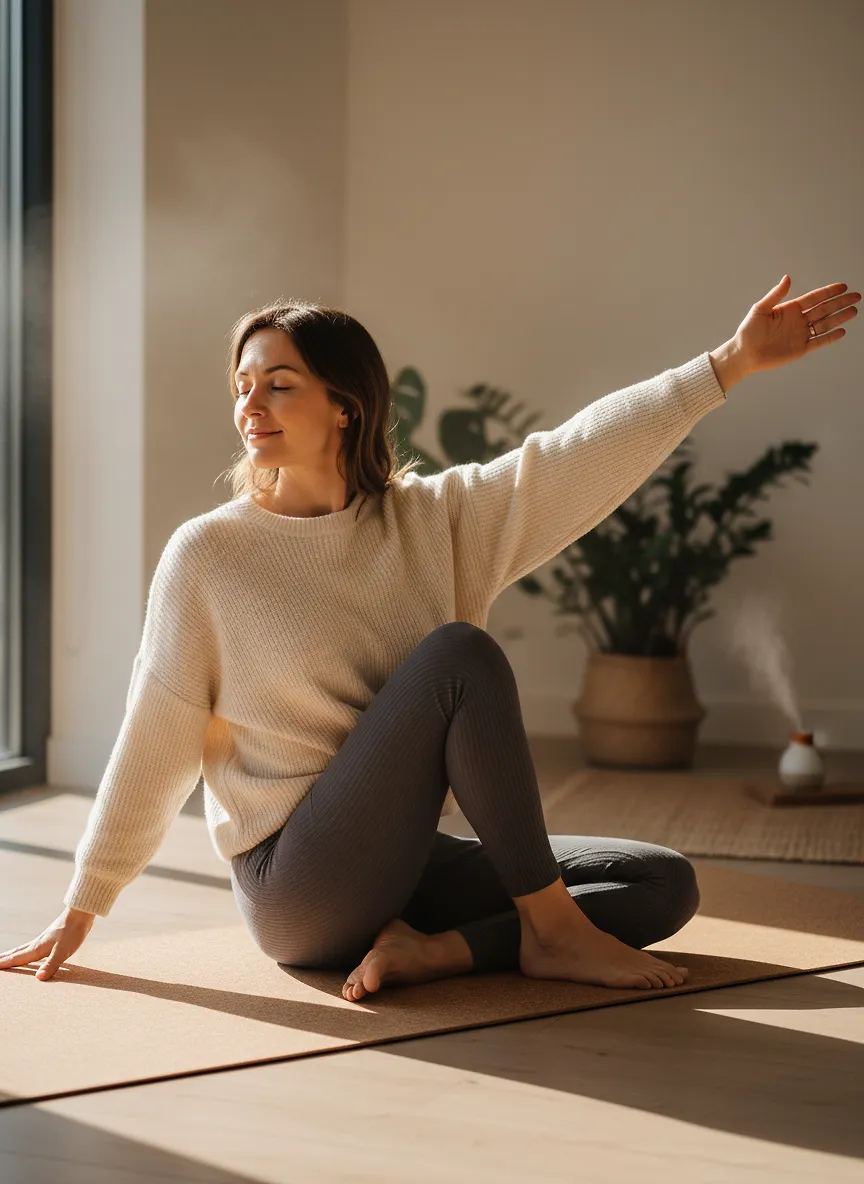
The 15-Minute Full-Body Stretch Routine
Let’s begin. Move through these stretches slowly, and let your breath be your guide. Never force anything. The edge you’re looking for is one of gentle sensation, not pain.
1. Centering Breath (1 Minute)
Come to a comfortable seated position, either cross-legged on the floor or on a chair with your feet flat. Rest your hands on your knees, palms up or down. Close your eyes. Take a deep breath in through your nose for four counts, feeling your belly expand. Hold for a moment. Then, exhale slowly through your mouth for six counts, letting everything go. Repeat this for one minute, simply noticing the rhythm of your own breath.
2. Gentle Neck Rolls & Shoulder Shrugs (2 Minutes)
This is my favorite for undoing “tech neck.” On an exhale, gently drop your chin to your chest. Inhale and slowly roll your right ear toward your right shoulder. Exhale as you roll back to center, and then inhale as you roll your left ear to your left shoulder. Continue this half-circle motion, avoiding tilting your head all the way back. After a few rounds, return to center. Inhale and shrug your shoulders up to your ears, holding the tension for a moment. Exhale with a sigh and let them drop completely. Repeat 3-5 times.
3. Cat-Cow Pose (2 Minutes)
Come onto your hands and knees in a tabletop position, with your wrists under your shoulders and your knees under your hips. On an inhale, drop your belly, lift your tailbone, and look slightly forward, opening your chest (Cow Pose). On an exhale, press the floor away, round your spine toward the ceiling, and tuck your chin to your chest (Cat Pose). Flow between these two poses, linking your breath to the movement. This feels like such a delicious, awakening movement for the entire spine.
4. Child’s Pose (2 Minutes)
From your tabletop position, bring your big toes to touch and widen your knees slightly. Sit your hips back onto your heels and fold forward, resting your forehead on the mat. You can extend your arms long in front of you or rest them alongside your body. This pose is incredibly grounding and a cornerstone of restorative practices. If you enjoy this feeling, I highly recommend exploring more in this beginner’s guide to restorative yoga for deep relaxation. Breathe deeply into your back, feeling your ribs expand with each inhale.
5. Low Lunge (2 Minutes – 1 per side)
From hands and knees, step your right foot forward between your hands. Slide your left knee back until you feel a gentle stretch in the front of your left hip and thigh (your hip flexors). Keep your hands on the floor, or for more intensity, bring them to your front knee. Hold here for 5-8 deep breaths, imagining you’re sending your breath directly to the area of sensation. Gently switch sides.
6. Seated Forward Fold (2 Minutes)
Come to a seated position with your legs extended in front of you. You can sit on a folded blanket to help tilt your pelvis forward. Inhale and sit up tall, lengthening your spine. On an exhale, begin to hinge at your hips and walk your hands forward. Stop when you feel a gentle stretch in your hamstrings and lower back. Keep a soft bend in your knees—this isn’t about touching your toes! Just let your head hang heavy and breathe.
7. Supine Spinal Twist (2 Minutes – 1 per side)
Lie on your back and hug both knees into your chest. Extend your arms out to a “T” shape. On an exhale, let both knees fall gently over to your right side. Turn your gaze to the left, if that feels comfortable for your neck. Focus on keeping both shoulders connected to the floor. This twist is wonderful for releasing the spine and aiding digestion. Hold for 5-8 breaths, then gently return to center and switch sides.
8. Final Stillness (2 Minutes)
Lie flat on your back, letting your feet fall open naturally. Rest your arms by your sides, palms facing up as a gesture of receiving. Close your eyes. Don’t try to do anything. Simply rest. Scan your body from your toes to the crown of your head, noticing any new feelings of openness or ease. Allow yourself these final moments to integrate the practice and simply be.
Making It a Habit: Weaving Movement Into Your Day
The hardest part of any new routine is, well, making it a routine. My best advice? Don’t put pressure on yourself. Start with the intention of doing it just for today. Then do the same tomorrow.
I remember when I first left my draining city job, my nervous system was so fried that the idea of adding *anything* else to my day felt overwhelming. As Elara Finch, the person I am now, it seems so simple, but back then, it was a mountain. So I started small. I decided to do this exact stretching routine every single day right after I shut my laptop. It became my non-negotiable transition from “work mode” to “rest mode.” It was the anchor in my evening, signaling to my body and mind that the day was done and it was time to soften.
You can “habit stack” this routine by linking it to something you already do. Perhaps it’s the first thing you do when you get out of bed, or maybe it becomes part of your wind-down at night. Pairing it with other calming activities can create a powerful sequence; for me, this routine is the perfect lead-in to a simple evening ritual to lower cortisol and unwind your day.
This practice isn’t about perfection. It’s about presence. It’s a quiet promise you make to yourself to show up, breathe, and listen to what your body needs.
I invite you to try this routine for a week. Notice how you feel. Do you sleep a little better? Do you feel a bit more space in your shoulders? More connected to your breath? The benefits are often subtle at first, but they build on each other, creating a profound shift over time.
This is your daily invitation to come home to your body. Accept it with kindness.
With calm and care,
Elara