Category: Calm Home

  • A Gentle Guide to a Weekend Digital Detox at Home

    A Gentle Guide to a Weekend Digital Detox at Home

    A Gentle Guide to a Weekend Digital Detox at Home

    Do you know that feeling? The phantom buzz in your pocket, even when your phone isn’t there. The reflexive reach for it first thing in the morning and last thing at night. The slight, gnawing anxiety that you’re missing something—an email, a message, a headline—if you’re not constantly connected. I know it all too well.

    I’m Elara Finch, and for years, my life in the city was a whirlwind of digital noise. My phone felt less like a tool and more like an extension of my own nervous system, constantly firing and demanding my attention. Burnout wasn’t just a possibility; it was an inevitability. It was in learning to intentionally disconnect, to reclaim my time and my attention, that I found my way back to balance. And I discovered that you don’t need to book a remote cabin in the woods to do it.

    Sometimes, the most radical and restorative act of self-care is simply unplugging from technology within the comfort of your own home. This is my personal, gentle guide to planning and truly enjoying a weekend digital detox. We’ll cover how to prepare your space and your mind, explore a list of soulful, screen-free activities, and talk about how to ease back into the digital world more intentionally than before.

    Part 1: The Gentle Preparation

    A successful, stress-free detox is all in the preparation. The goal is to create an environment where you feel supported and calm, not deprived and antsy. Think of it not as taking something away, but as making space for something new.

    Set Your Intention (And Your ‘Out of Office’)

    Before you even think about turning off your phone, take a moment to ask yourself: Why am I doing this? Your intention is your anchor. Perhaps you want to:

    • Feel more present in your own life.
    • Reconnect with your partner or family without glowing screens between you.
    • Finish that novel that’s been sitting on your nightstand for months.
    • Give your mind a genuine break from the constant influx of information.
    • Simply get a good night’s sleep.

    Write your intention down and place it somewhere you can see it. This isn’t about productivity; it’s about purpose. Once you have your ‘why’, handle the logistics:

    Inform the key people: Send a simple text to close family or friends letting them know you’ll be offline for the weekend. Something like, “Hey! Just a heads up, I’m doing a digital detox this weekend to recharge. I’ll be off my phone but will get back to you on Monday. All is well!” This single step can alleviate so much anxiety—both for you and for them.

    Download what you need: A digital detox doesn’t mean you can’t listen to music or an audiobook. The key is to prepare. Download your playlists, podcasts, or books beforehand so you can access them without needing an internet connection. This is a practical compromise that makes the whole experience more enjoyable.

    Prepare Your Calm Home

    Now, let’s make your home an irresistible analog sanctuary. The goal is to make the offline world more appealing than the online one. Tidy up your main living areas. A clear space helps support a clear mind. Then, “stage” your home for your detox weekend.

    • Lay out that stack of magazines or books on the coffee table.
    • Place your journal and a favorite pen on your nightstand.
    • Pull out the board games or a puzzle and leave them in view.
    • Unroll your yoga mat in a quiet corner.
    • Make sure you have ingredients for a favorite meal or for baking.

    By setting these items out, you’re giving your future self gentle, visual cues for what’s possible beyond the screen. It’s an invitation to engage with the physical world around you.

    Part 2: A Menu of Soulful, Screen-Free Activities

    Okay, the time has come. You’ve set your intention, prepped your space, and now you turn off your phone, your laptop, your tablet. You might even put them in a box or a drawer in another room. The first hour can feel… strange. You might feel bored, restless, or antsy. This is completely normal! It’s the feeling of your brain recalibrating. My first time, I paced my apartment for twenty minutes, unsure of what to do with myself. Then, I remembered my intention—to rest—and I finally sat down with a cup of tea and just breathed. The stillness eventually felt less like a void and more like a relief.

    Here is a menu of ideas to help you fill your weekend with presence and peace. Pick and choose what calls to you.

    Mindful Mornings

    Without the pull of your phone, how might your morning change? Wake up naturally, without an alarm if you can. Notice the quality of the light in your room. Instead of scrolling, try one of these:

    • Gentle Movement: Do a few simple stretches in bed or roll out your mat for some quiet movement. You don’t need a guided class to simply listen to what your body needs. For deep relaxation, you might explore some poses from a beginner’s guide to restorative yoga you’ve practiced before.
    • Savor Your Coffee or Tea: Make your morning beverage a ritual. Pay attention to the aroma, the warmth of the mug in your hands, the taste. Don’t do anything else. Just sit and sip for five minutes.
    • Morning Pages: Open a journal and write. Let whatever is on your mind flow onto the page without judgment. It’s a wonderful way to clear out mental clutter.

    Engaging Afternoons

    The afternoon, often a time for a mindless scroll, can become a time for creativity and connection.

    • Get Lost in a Book: There is no pleasure quite like sinking into a comfortable chair and reading a physical book for an uninterrupted hour or two.
    • Go Outside: Take a walk around your neighborhood. Leave your headphones behind and just notice. What do you see? What do you hear? What does the air smell like? This is a beautiful way to practice mindfulness without any formal meditation. If you’re looking for more ways to integrate this into your life, you might enjoy my guide to mindfulness without formal meditation.
    • Create Something: You don’t have to be an artist. Doodle, paint, knit, write a letter to a friend, try a new recipe, or even just rearrange a bookshelf. The act of making something with your hands is deeply grounding.
    • Tackle a Small Project: The satisfaction of organizing that one messy drawer, weeding a small garden bed, or finally sewing a button back on a shirt is surprisingly immense.

    Restorative Evenings

    As evening falls, lean into the quiet and calm.

    • Cook a Nourishing Meal: Put on some music and enjoy the process of chopping and cooking. This is a sensory experience—the sizzle of garlic in a pan, the bright colors of fresh vegetables.
    • Listen to an Album: I mean really listen. Put on a favorite record or a pre-downloaded album from start to finish, without multitasking.
    • Connect with Loved Ones: If you live with others, use this time for a real conversation. Play a card game. Share stories. If you live alone, use the time to connect with yourself.
    • Create an Unwind Ritual: Take a warm bath with Epsom salts, sip a cup of herbal tea, and read a few pages of a light novel. This is a perfect way to signal to your body that it’s time to rest. For more ideas, you can explore creating a simple evening ritual to lower cortisol and unwind your day.

    Part 3: The Gentle Re-Entry

    Your weekend of unplugging from technology is over. How do you re-enter the digital world without undoing all that calm you’ve cultivated? The key is intention.

    Easing Back In

    Don’t let turning on your phone be the first thing you do on Monday morning. Enjoy your now-familiar, quiet morning routine. Have your coffee. Do your stretches. When you do decide to reconnect, do it purposefully.

    Instead of opening a floodgate of notifications, perhaps you check only your text messages first. Then, a bit later, your email. You are in control, not the notifications.

    Carrying the Calm Forward

    The most powerful part of a digital detox is what you learn from it. Take a moment to reflect. What did you enjoy most? What did you truly miss? What, to your surprise, did you not miss at all?

    Use these insights to set new, gentle boundaries for yourself:

    • Maybe you commit to a “no phones in the bedroom” rule.
    • Perhaps you turn off notifications for a few particularly noisy apps.
    • You could schedule a screen-free hour every evening or one tech-free day a month.

    A weekend digital detox isn’t about demonizing technology; it’s about remembering that it’s a tool we can choose to pick up and put down. It’s about reclaiming your time, your focus, and your connection to the quiet, beautiful world that exists right in front of you.

    Give it a try. Be gentle with yourself. You might be surprised by the peace you find when you finally give yourself permission to unplug.

    With calm and care,
    Elara

  • My Guide to Creating a Calming Bedroom for Deeper Sleep

    My Guide to Creating a Calming Bedroom for Deeper Sleep

    My Guide to Creating a Calming Bedroom for Deeper Sleep

    Do you know that feeling? It’s 2 AM, the house is silent, and you’re lying in bed, physically exhausted but with a mind that’s running a marathon. I know it intimately. For years, I’d stare at the ceiling, my thoughts tangled in to-do lists, replaying conversations, and worrying about the next day—all while desperately wishing for sleep to find me.

    Back in my city life, my bedroom wasn’t just a bedroom. It was my part-time office, my overflowing closet, the place I’d fold laundry, and sometimes, where I’d eat a hurried dinner. It was a room of action, not rest. And my sleep—or lack thereof—was a direct reflection of that chaotic energy. It was a key ingredient in my journey to burnout, a nightly reminder that I was completely out of balance.

    It wasn’t until I began my journey toward intentional calm that I realized one of the most powerful changes I could make wasn’t in a supplement bottle or a new meditation app. It was right there, within the four walls of my own bedroom. Transforming my sleeping space from a multi-purpose zone into a true sanctuary was, without a doubt, a turning point for my health. It taught me that our environment sends powerful signals to our brains, and we have the ability to curate those signals to invite peace and deep, restorative rest.

    In this guide, I want to share the simple, practical steps I took to create a calming bedroom for better sleep. This isn’t about a costly renovation; it’s about making small, intentional choices that signal to your body and mind that this space is sacred—a haven for rest and renewal.


    Why Your Bedroom Environment Is a Secret Ingredient for Great Sleep

    Before we dive into the “how,” let’s touch on the “why.” It’s not just a nice idea that a pretty room helps you relax; there’s real science behind it. Our bodies are beautifully attuned to our surroundings, operating on an internal 24-hour clock called the circadian rhythm. This rhythm governs our sleep-wake cycle, and it’s profoundly influenced by external cues—light and darkness being the most powerful.

    When our brains perceive darkness, they get the memo to produce melatonin, the wonderful hormone that makes us feel sleepy. Conversely, exposure to light—especially the blue light from our phones, TVs, and bright overhead fixtures—sends a “wake up!” signal, suppressing melatonin production and keeping us alert.

    But it’s more than just light. Clutter, for example, is a form of visual noise. A messy, disorganized space can subtly increase our levels of cortisol, the primary stress hormone. When you’re surrounded by piles of clothes that need to be put away, a stack of work papers, or exercise equipment, your brain doesn’t see a place of rest. It sees a to-do list. And who can sleep soundly with a to-do list looming over them?

    By consciously designing our bedroom to be a sleep sanctuary, we’re not just decorating. We’re engaging in a powerful form of self-care. We’re telling our nervous system, “It’s safe to let go. It’s time to unwind.”

    My Step-by-Step Guide to Creating Your Sleep Sanctuary

    Ready to turn your bedroom into the peaceful haven you deserve? Here are the four pillars I focused on. Remember, you don’t have to do it all at once. Start with the one that feels most achievable for you.

    Step 1: Let There Be (the Right Kind of) Light

    Controlling the light in your bedroom is probably the single most impactful change you can make for your sleep quality. The goal is to create a space that is truly dark at night and filled with gentle, warm light in the hour or two before bed.

    • Embrace the Darkness: Invest in a good set of blackout curtains or blinds. It’s amazing how much ambient light seeps in from streetlights or a bright moon. You want your room to be as close to pitch-black as possible while you’re sleeping. If curtains aren’t an option, a comfortable eye mask is a fantastic alternative.
    • Warm Up Your Lighting: Swap out harsh, cool-toned overhead lights for softer, warmer options. Think bedside lamps with low-wattage, warm-hued bulbs (look for bulbs around 2700K). A salt lamp can also cast a beautiful, soothing amber glow. The idea is to mimic the colors of a sunset, which naturally signals to our brain that it’s time to wind down.
    • Create a Screen-Free Zone: This was a hard one for me, but it made all the difference. I now commit to putting my phone away at least an hour before I plan to sleep. That blue light is a notorious melatonin-suppressor. Instead of scrolling, I use that final hour for reading a physical book or journaling. This practice is a core part of creating a simple evening ritual to lower cortisol and unwind your day.

    Step 2: Choose Textiles That Feel Like a Hug

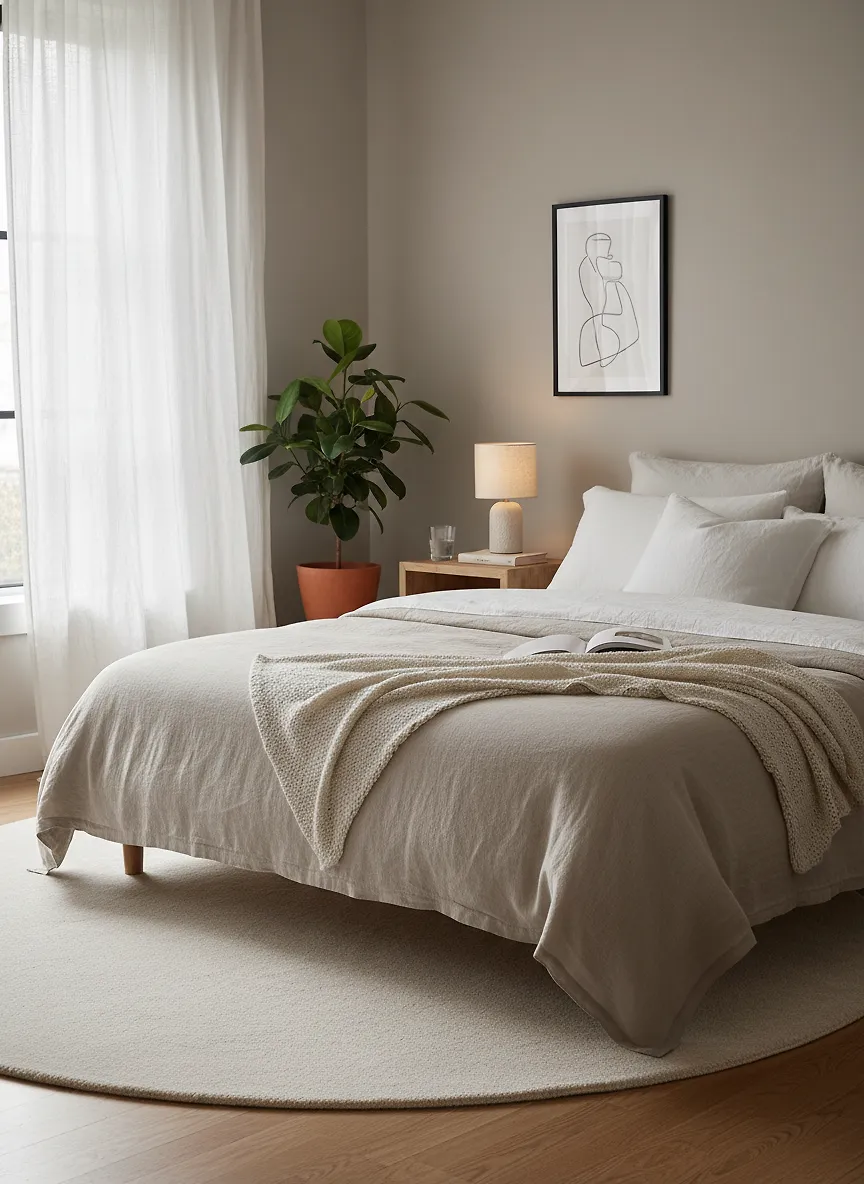
    The things that touch your skin matter. Your bedding, pillows, and even the rug your feet land on in the morning contribute to the overall feeling of your sanctuary. The focus here is on natural materials, comfort, and breathability.

    I used to buy whatever bedding was on sale, often ending up with stiff, synthetic fabrics that would trap heat and leave me feeling tangled and sweaty. My big upgrade was investing in a set of linen sheets. They felt a bit strange at first, but with every wash, they’ve become impossibly soft and comforting. Linen is wonderfully breathable, keeping me cool in the summer and warm in the winter.

    You don’t have to choose linen, of course. Organic cotton, bamboo, and Tencel are all beautiful, breathable options. Consider layering your bedding—a light sheet, a quilt, and a duvet—so you can easily adjust to your body’s temperature throughout the night. A soft, plush rug next to your bed can also make getting up in the morning a much gentler experience.

    Step 3: Declutter Your Space, Declutter Your Mind

    This is where my friend Elara Finch’s philosophy really comes into play. I truly believe that a cluttered space leads to a cluttered mind. When I finally made the commitment to get my work desk, my stationary bike, and the infamous “clothes chair” (you know the one) out of my bedroom, the shift in energy was palpable. My room could finally breathe, and so could I.

    Your bedroom should have one primary purpose: rest. To support this, try to remove anything that reminds you of work, chores, or stress.

    • Designate a Home for Everything: Use beautiful woven baskets for throw blankets, get a nightstand with drawers to hide away odds and ends, and commit to putting your clothes away at the end of the day.
    • Clear the Surfaces: Keep your dresser and nightstand tops as clear as possible. A few cherished items—a framed photo, a special candle—are fine, but avoid letting them become a drop-zone for clutter.
    • Relocate Work and Fitness: If at all possible, find a new home for your desk and any exercise equipment. Creating this physical boundary is a powerful psychological cue that helps you mentally clock out for the day. This act of clearing your space is, in itself, a wonderful practice in mindfulness without formal meditation—it’s about being present and intentional with your environment.

    Step 4: Engage Your Senses with Calming Scents

    Our sense of smell is directly linked to the parts of our brain that process emotion and memory. You can use this to your advantage by associating a specific, calming scent with sleep.

    I love using an essential oil diffuser in the evening. About an hour before bed, I’ll add a few drops of lavender or a blend of cedarwood and chamomile. The gentle scent fills the room and has become an immediate signal to my nervous system that it’s time to slow down. A simple pillow mist with a similar scent can also be a lovely touch.

    A quick note: a little goes a long way! The goal is a subtle, soothing aroma, not an overpowering fragrance that might be disruptive. And always make sure to air out your room during the day by opening the windows to let fresh air circulate.

    Putting It All Together: Your Bedroom as a Daily Ritual

    Creating a sleep sanctuary isn’t a one-and-done project. It’s a practice. It’s the daily ritual of making your bed in the morning, which sets the tone for a calm space. It’s the evening act of tidying up for five minutes, dimming the lights, and turning on your diffuser.

    These small, consistent actions reinforce the purpose of your bedroom. They build on each other, creating a powerful feedback loop: a calm space encourages a calm mind, which leads to better sleep, which gives you the energy to maintain your calm space. It’s a beautiful cycle of self-care.

    Please don’t feel overwhelmed or think you need a huge budget. Start small. Tonight, just try clearing everything off your nightstand except a lamp and a book. See how that feels. Next week, maybe you commit to putting your phone to charge across the room. These gentle shifts are the foundation of a more restful life.

    Your bedroom is so much more than a place to crash at the end of the day. It’s the space where you begin and end each day, where you are at your most vulnerable. By treating it with intention and care, you are giving yourself the profound gift of true, deep rest. And that is a gift that will ripple out into every other corner of your life.

    With calm and care,
    Elara